Field Fence Installation Services
Field Fence Installation Kings provides field fence installation, woven wire fence installation, and pasture fence replacement services nationwide for farms, homesteads, rural homes, and commercial properties, from small garden runs to whole pastures. Contact us now for a free estimate.
How Much Does Field Fence Installation Cost?
Field fence installation costs anywhere from $2,500 to $6,500 on average for about 1,000 feet of 4 to 5 foot woven wire with braced corners and one gate. The price depends on the total length, wire height and style, post type and spacing, the number of corners and gates, rock, slope, and wet ground, and any clearing or old fence removal.
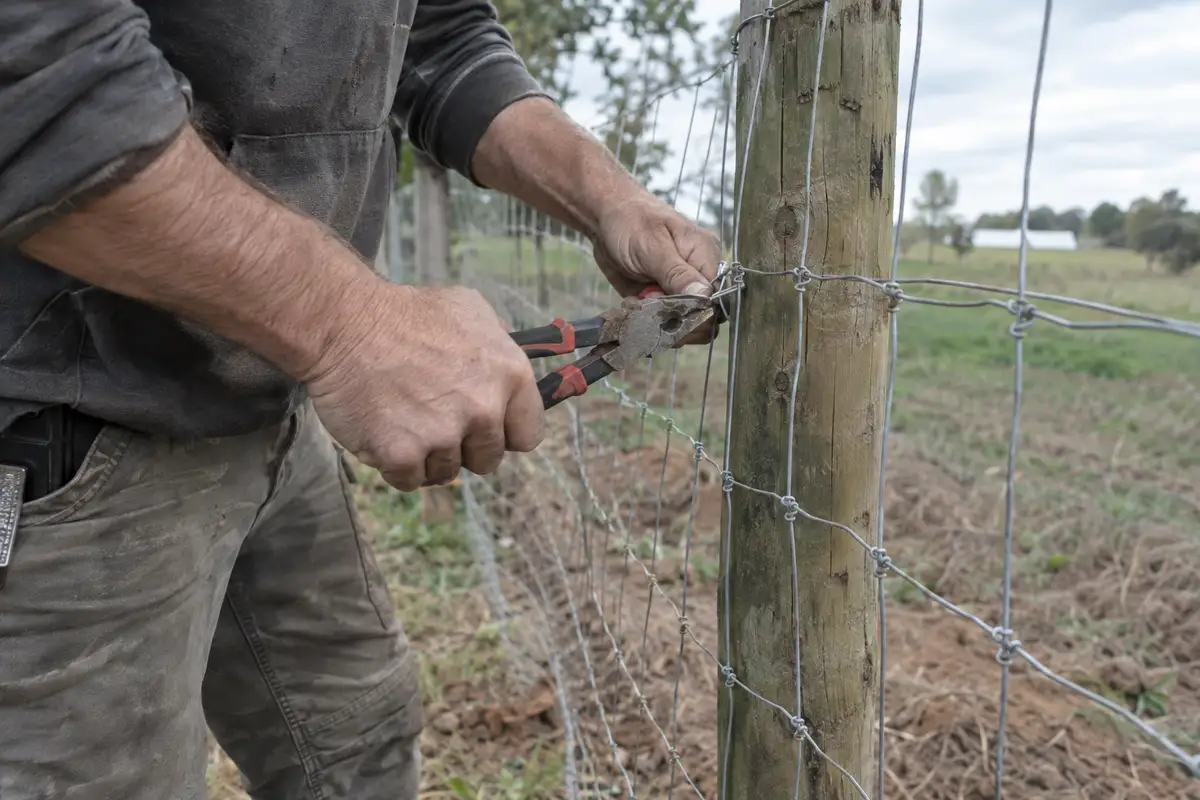
Do You Install Field Fence for Farms, Homesteads, and Businesses?
Yes, we install field fence on farms, ranches, homesteads, rural homes, and commercial properties. Tell us what the fence needs to hold in or keep out and roughly how many feet you need.
Do You Service My Area?
Yes, in most cases. Send us the address and we'll confirm.
Is Field Fence Priced by the Foot?
Yes, we quote most jobs per linear foot, typically $2 to $6 installed. Gates, corner braces, and clearing are often priced on top, and short runs cost more per foot.
How Much Does It Cost to Fence an Acre?
A square 1 acre pasture needs about 835 feet of fence, so we typically see $1,700 to $5,000 installed at $2 to $6 a foot. Bigger fields cost less per acre because the perimeter grows more slowly than the area.
Can I Get a Price Before the Work Begins?
Yes, we confirm the price before starting. If we hit solid rock or buried debris while driving posts, we talk to you before doing any extra work.
How Soon Can You Start My Field Fence?
We schedule the work once 811 has marked the utilities and the wire and posts are on hand. Lead times vary with the season, so tell us if you need animals fenced in by a set date.
What Information Do You Need for a Field Fence Quote?
We need the address, the approximate length, the animals involved, the height you want, and the number of gates. A rough sketch or satellite map of the fence line and photos of any brush, rock, or creeks help most.
Will I Need to Be There While You Build the Fence?
No, as long as the line is marked and we can reach it. It helps to walk the line with us on the first day to confirm corners and gate spots.
Do I Need a Survey Before You Fence a Property Line?
Yes, if you aren't sure where the line is. We build to the line you show us, and a survey, typically $400 to $1,500, costs less than moving a finished fence.
Do I Need to Call 811 Before You Drive Posts?
No, we typically request the 811 locate before we drive any posts. It doesn't mark private lines like wells, water lines, or buried electric runs to barns, so point those out to us.
Do I Need a Permit for a Field Fence?
Yes, in some places. Some counties and towns require one, especially inside city limits or along roads, while many farm fences need none. Your local zoning office decides, and we can tell you what's usually needed.
Can I Have Field Fence Installed on Land I Lease?
Yes, with the landowner's written permission. Agree up front on who pays and who owns the fence when the lease ends.
How Long Does Field Fence Installation Take?
We typically build 200 to 500 feet a day on open, level ground, so 1,000 feet usually takes 2 to 4 days. Rock, slopes, corners, and gates add time.
What Height Field Fence Do I Need?
Field fence comes from about 26 to 49 inches tall. We put up 39 or 47 inch fence on most pastures, and the right height depends on the animals you keep.
Which Field Fence Is Right for Cattle?
We usually suggest 47 inch fence with 12 inch stays and one strand of barbed or hot wire on top. Cattle don't need small openings, so wider stays keep the cost down.
Can You Install Field Fence for Goats?
Yes, but goats need openings too small for their heads to pass through. Wide upper openings trap horned goats, so we usually suggest 4x4 inch mesh or field fence with close 6 inch stays.
Can You Install Field Fence for Sheep?
Yes, we fence sheep with woven wire that has close spacing near the bottom, usually 6 inch stays or 4x4 inch mesh. Tell us the breed and whether you also run goats.
Will Field Fence Hold Hogs?
Yes, in most cases, if it sits tight to the ground with a barbed or electric strand along the bottom. Hogs root under loose woven wire.
Will Field Fence Keep My Dogs In?
Yes, for most dogs, if the bottom openings are small and the fence sits tight to the ground. Diggers and jumpers may need a bottom strand or a taller fence, so tell us the breed.
What Do the Numbers on a Field Fence Roll Mean?
A style like 1047-6-12 1/2 means 10 horizontal wires, 47 inches tall, stays 6 inches apart, and 12 1/2 gauge wire. Send us the number if you've already picked a roll.
Which Is Better, Fixed Knot or Hinge Joint Field Fence?
Fixed knot is stronger and lets us space posts much farther apart. Hinge joint is the budget choice and flexes over rolling ground, but needs more posts. Tell us the animals and the terrain.
Is High Tensile Field Fence Better Than Low Carbon?
Yes, for long runs. High tensile wire is lighter and stronger and resists sagging. Low carbon wire is easier to work but stretches over time, so we set more posts for it.
Does the Galvanizing on Field Fence Matter?
Yes, a heavier zinc coating lasts much longer. We prefer Class 3 galvanized wire, which is commonly rated for 30 to 40 years.
How Long Does Field Fence Last?
Well-built field fence with heavily galvanized wire can last 30 years or more. Treated wood posts typically last 10 to 25 years, so posts usually wear out before the wire.
Can You Add Barbed Wire Along the Top of Field Fence?
Yes, one strand of barbed wire a few inches above the woven wire is common on cattle fence. It stops animals from leaning over and mashing the top down.
Can You Add an Electric Wire to My Field Fence?
Yes, we can run an offset hot wire on standoff insulators at the top, bottom, or nose height. It keeps animals off the mesh and makes the fence last longer. Electric add-ons typically run $0.50 to $2.50 a foot.
Can You Install Gates in a Field Fence?
Yes, we hang walk gates and wide pipe gates for tractors and trailers, typically $150 to $700 each installed. Every gate needs braced posts, so tell us the width and where animals and equipment move most.
Can You Install Field Fence on Hills and Uneven Ground?
Yes, we set extra posts in dips and on crests so the wire follows the ground without gaps underneath. Hinge joint fence flexes best over rolling land, and steep or broken ground adds to the price.
Can You Install Field Fence in Rocky Ground?
Yes, but rock slows post driving and can mean drilling or augering holes. Rocky or wet ground often adds 15% to 50% to the cost.
Can the Fence Cross a Creek or Ditch?
Yes, we usually brace both banks and hang a separate water gap across the channel so high water doesn't tear out the main fence. Tell us how wide the crossing is and how high it floods.
Do You Clear Brush and Trees Along the Fence Line?
Yes, we can clear the line first, typically for $0.50 to $2 a foot.
Can You Replace My Old Woven Wire Fence?
Yes, we roll up the old wire, pull the posts, and haul it away, typically $1 to $3 a foot. Sound wood corner posts can sometimes stay, but rusted wire should not be reused.
Can You Install Field Fence in Winter?
Yes, in most cases, as long as the ground isn't frozen hard. Frozen soil makes driving posts and setting corners difficult, so deep winter jobs may wait for a thaw.
Should I Move My Animals Before You Start?
Yes, keep them out of the work area until the fence is finished and the gates are hung.
How Far Apart Do You Space Field Fence Posts?
We usually space line posts 8 to 12 feet apart, closer on hills and in soft ground. High tensile fixed knot fence can go much farther between posts.
What Posts Do You Use for Field Fence?
We use steel T-posts for most line posts, a treated wood post every few posts for stiffness, and wood posts at every corner, end, and gate.
How Do You Build the Corners and Braces?
We build H-braces with 6 to 8 inch wood posts set at least 3.5 feet deep, a horizontal brace, and a tightened diagonal brace wire. Most fence failures start at a weak corner, so this is where we spend the time.
How Do You Get Field Fence Tight?
We clamp the wire in stretcher bars and pull it from corner to corner before stapling. A tight fence springs back when you push on it, and loose wire sags and lets animals through.
Which Side of the Posts Does the Wire Go On?
The animal side, so leaning stock push the wire into the posts.
Can I Install Field Fence Myself?
Yes, many owners do, and materials alone typically run $0.75 to $2.50 a foot. Solid corner braces and even tension are the hard parts, and we can often build just the corners and gates if you'd rather run the wire.
Areas We Cover
We take requests in most of the country. These are the cities we have a page for, by state:
Alabama
- Eufaula, AL
- Foley, AL
- Gadsden, AL
- Madison, AL
- Millbrook, AL
- Northport, AL
- Opelika, AL
- Talladega, AL
- Troy, AL
- Vestavia Hills, AL
Arizona
Arkansas
California
Colorado
Delaware
Florida
- Auburndale, FL
- Boca Raton, FL
- Bonita Springs, FL
- Clermont, FL
- Key West, FL
- Lynn Haven, FL
- Navarre, FL
- Ocala, FL
- Palm Bay, FL
- Palm Coast, FL
- Plantation, FL
- Port Charlotte, FL
- Sanford, FL
- Sunrise, FL
- Tarpon Springs, FL
- Venice, FL
- Wellington, FL
- Wesley Chapel, FL
Georgia
- Brunswick, GA
- Douglas, GA
- Dunwoody, GA
- Grovetown, GA
- Jesup, GA
- Johns Creek, GA
- Marietta, GA
- Milledgeville, GA
- Moultrie, GA
- Valdosta, GA
- Vidalia, GA
- Warner Robins, GA
Idaho
Illinois
Indiana
Iowa
Kansas
Kentucky
Louisiana
Maine
Maryland
Michigan
Minnesota
Mississippi
Missouri
Montana
Nebraska
New Hampshire
New Mexico
New York
North Carolina
- Albemarle, NC
- Concord, NC
- Henderson, NC
- Kannapolis, NC
- Kernersville, NC
- Laurinburg, NC
- Leland, NC
- Morrisville, NC
- Sanford, NC
- Shelby, NC
Ohio
- Athens, OH
- Bowling Green, OH
- Brunswick, OH
- Centerville, OH
- Findlay, OH
- Forest Park, OH
- Fremont, OH
- Hilliard, OH
- Kent, OH
- Lakewood, OH
- Massillon, OH
- New Philadelphia, OH
- Newark, OH
- Niles, OH
- Sidney, OH
- Tiffin, OH
Oklahoma
Oregon
Pennsylvania
- Bloomsburg, PA
- Coolbaugh, PA
- Exeter Township, PA
- Hempfield, PA
- Lower Merion, PA
- Manchester Township, PA
- Manheim Township, PA
- Mount Lebanon, PA
- New Castle, PA
- Norristown, PA
- Palmer, PA
- Swatara, PA
- Upper Merion, PA
- Williamsport, PA
South Carolina
South Dakota
Tennessee
- Bristol, TN
- Cleveland, TN
- Collierville, TN
- Columbia, TN
- East Ridge, TN
- Elizabethton, TN
- Franklin, TN
- Lawrenceburg, TN
- Manchester, TN
- Maryville, TN
- McMinnville, TN
- Millington, TN
- Pulaski, TN
Texas
- Allen, TX
- Baytown, TX
- Bedford, TX
- Bellmead, TX
- Brenham, TX
- Canyon Lake, TX
- Carrollton, TX
- Cedar Park, TX
- Converse, TX
- Del Rio, TX
- Gatesville, TX
- Huntsville, TX
- Mercedes, TX
- Missouri City, TX
- Paris, TX
- Plainview, TX
- Pleasanton, TX
- Robstown, TX
- Round Rock, TX
- San Elizario, TX
- Stephenville, TX
- Sugar Land, TX
- Texas City, TX
- Vidor, TX
- Waxahachie, TX
Utah
Vermont
Virginia
Washington
West Virginia
Wisconsin
Wyoming
